Leave Your Message
Choosing the right Home Car Charger in 2026 requires more than comparing charging speed or purchase price. Global buyers face different voltage systems, connector standards, weather conditions, and household electrical limits. A charger suitable for a London townhouse may not fit a Canadian garage or a South African home.
This guide introduces the main home charging types, including portable chargers, wall-mounted AC units, tethered models, and socket-based systems. Each option has practical strengths. Portable units support flexibility, while fixed chargers usually offer better daily convenience and cable management. Smart chargers can balance vehicle demand with household consumption. Some models also support solar integration or scheduled charging, but compatibility must be verified carefully.
Safety remains central. Buyers should check rated current, protection features, enclosure durability, and installation requirements. A qualified electrician should assess the circuit before installation. Manufacturer documentation and regional certification matter more than attractive marketing claims. Charging performance can also change with battery temperature, cable length, and the vehicle’s onboard AC limit.
There is no universal winner.
The most expensive charger is not always the best choice. A modest 7 kW unit may suit a driver who parks overnight, while a larger system may benefit a high-mileage household with adequate electrical capacity. Still, product specifications can be confusing, and some comparisons oversimplify real-world use. This overview aims to make those decisions clearer, while acknowledging that local conditions must guide the final purchase.
Home Car Charger Basics and Charging Technology
Home charging begins with the electrical connection, not the charger screen. An AC home unit supplies controlled power to the vehicle, while the car’s onboard charger converts AC into stored DC energy. Level 1 usually uses a standard 120-volt outlet and adds roughly 3–8 kilometers of range per hour. Level 2 commonly uses 208 or 240 volts and can deliver about 7–22 kW, depending on the vehicle and household circuit. A small detail matters: the car may accept less power than the charger advertises.
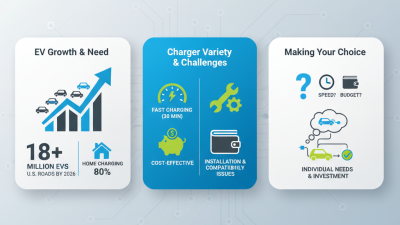
The International Energy Agency reported more than 17 million electric cars sold worldwide in 2024, representing over 20% of new car sales. This growth increases interest in reliable overnight charging. For many homes, a 7.4 kW unit can refill a 60 kWh battery in approximately eight hours, before charging losses. Actual time varies with temperature, battery condition, and charge limits. Bigger is not always better. A high-power unit may require costly electrical upgrades and deliver no extra benefit to a vehicle with a lower onboard limit.
Safety depends on installation quality. The U.S. Department of Energy recommends using dedicated circuits and qualified electrical assessment for home charging equipment. Protection against residual current, overheating, and poor grounding should be verified before daily use. Smart charging can reduce peak-load pressure by delaying sessions until electricity demand falls. However, network features can fail, and offline operation still matters. Homeowners should check cable length, enclosure rating, local voltage, and emergency shutoff access. The simplest setup is often the most dependable.
| Home Charger Type | Charging Technology | Typical Input and Output | Approximate Range Added per Hour | Approximate Time to Add 60 kWh | Installation Requirements | Best Use Case | Main Advantages | Important Limitations |
|---|---|---|---|---|---|---|---|---|
| Portable AC Level 1 Charger | AC charging On-board charger Grid AC is converted to DC by the vehicle's on-board charger. |
Commonly 100–120 V AC Approximately 1.4–1.9 kW at 12–16 A |
Approximately 5–8 km or 3–5 miles, depending on vehicle efficiency | Approximately 30–45 hours | A grounded household outlet with suitable circuit protection. Continuous high-current use should be checked by a qualified electrician. | Overnight charging, plug-in hybrids, low-mileage driving, and emergency backup | Low equipment cost, simple setup, high portability, and broad household compatibility | Slow charging speed and possible outlet or circuit heating if the electrical installation is unsuitable |
| Single-Phase AC Level 2 Charger | AC charging Smart control The vehicle's on-board charger determines the actual charging rate. |
Commonly 208–240 V AC Approximately 3.7–7.4 kW at 16–32 A |
Approximately 25–50 km or 15–30 miles | Approximately 8–16 hours | A dedicated circuit, suitable wiring, residual-current protection, grounding, and professional installation are generally recommended. | Most private homes, daily commuting, and overnight full charging | Good balance of speed, cost, energy efficiency, and installation complexity | Requires compatible household voltage and sufficient electrical capacity; charging speed is limited by the vehicle's AC input rating |
| Three-Phase AC Home Charger | AC charging Three-phase power Power is delivered through the vehicle's AC on-board charger. |
Commonly 380–415 V AC three-phase Approximately 11–22 kW at 16–32 A |
Approximately 70–140 km or 45–85 miles | Approximately 3–6 hours | Three-phase residential service, a dedicated circuit, load assessment, appropriate protection devices, and qualified installation. | Homes with three-phase electricity, high daily mileage, and larger battery vehicles | Much faster AC charging and efficient use of available three-phase power | Not available in every residence; the vehicle must support three-phase AC charging, and installation costs can be higher |
| Tethered Wall-Mounted AC Charger | Fixed cable AC charging Integrated cable connects directly to the vehicle. |
Usually 3.7–22 kW AC Current ratings commonly range from 16–32 A |
Approximately 25–140 km or 15–85 miles, depending on power and vehicle efficiency | Approximately 3–16 hours | Permanent wall or pedestal mounting, dedicated circuit, grounding, overcurrent protection, and residual-current protection. | Regular home parking where convenience and frequent charging are priorities | Fast connection, tidy parking-area layout, reduced cable handling, and convenient daily operation | Less flexible when vehicles use different inlet standards; the cable is exposed to outdoor wear if not properly stored |
| Socketed AC Wall-Mounted Charger | Replaceable cable AC charging The user selects a detachable charging cable compatible with the vehicle. |
Usually 3.7–22 kW AC Single-phase or three-phase configurations |
Approximately 25–140 km or 15–85 miles | Approximately 3–16 hours | Permanent installation with a dedicated circuit and protection equipment. The correct detachable cable must be used. | Multi-vehicle households, changing vehicle fleets, and users who travel across regions | Greater connector flexibility, easier cable replacement, and convenient compatibility management | Requires separate cable storage and may be less convenient for daily plug-in use |
| Connected Smart AC Charger | Wi-Fi or cellular Load management Charging can be scheduled or adjusted through an application, energy meter, or home energy system. |
Usually 3.7–22 kW AC Output power depends on the selected AC charging configuration |
Approximately 25–140 km or 15–85 miles | Approximately 3–16 hours | Normal AC charger installation plus reliable communications, network configuration, and optional integration with a household energy meter. | Time-of-use electricity plans, solar-assisted charging, and homes with limited grid capacity | Scheduled charging, dynamic load balancing, energy monitoring, remote control, and potential cost optimization | Higher purchase complexity, dependence on software or connectivity, and possible subscription or data requirements |
| Solar-Integrated AC Charger | Solar-aware charging Energy management Uses solar generation data to prioritize renewable electricity or coordinate charging with the grid. |
Usually 3.7–22 kW AC Actual solar-only power varies with photovoltaic output, weather, and household demand |
Approximately 25–140 km or 15–85 miles when sufficient power is available | Approximately 3–16 hours from grid-supported AC charging; solar-only charging may take longer | Compatible solar inverter or energy meter, suitable electrical protection, and coordinated installation of the charger and energy-management system. | Homes with photovoltaic generation and users seeking higher renewable-energy utilization | Can increase self-consumption of solar energy, reduce some grid demand, and support intelligent energy scheduling | Performance varies with sunlight and household loads; it usually requires more equipment and configuration |
| Residential DC Fast Charger | DC charging Off-board conversion AC-to-DC conversion takes place inside the charger, allowing direct DC delivery to the vehicle battery. |
Commonly about 20–50 kW DC for residential or small-site applications Higher power requires substantially larger electrical infrastructure |
Approximately 100–300 km or 60–185 miles | Approximately 1–3 hours, depending on the vehicle's DC charging curve | High-capacity electrical service, dedicated protection and isolation equipment, professional engineering, ventilation or thermal management as required, and local approval. | High-mileage homes, shared residential facilities, commercial residences, and rapid turnaround requirements | Much faster charging and reduced dependence on the vehicle's AC on-board charger | High equipment and installation cost, greater demand on the electrical network, more heat, and limited suitability for ordinary single-family homes |
| Wireless or Inductive Home Charger | Contactless power transfer Magnetic field coupling Power transfers between a ground pad and a vehicle-side receiver without a conductive plug. |
Commonly designed for several kilowatts of AC-equivalent charging Power depends on the system design and vehicle receiver |
Approximately 25–70 km or 15–45 miles per hour for typical home-oriented systems | Approximately 9–24 hours | Ground-pad alignment, vehicle-side receiver compatibility, precise installation, and compliance with electromagnetic-safety requirements. | Accessible parking spaces, automated charging, and users prioritizing plug-free convenience | No exposed charging connector during operation, convenient alignment-based charging, and reduced cable handling | Higher cost, lower availability, alignment sensitivity, and compatibility limitations compared with conductive AC charging |
Note: Charging times and driving-range estimates are indicative values based on adding approximately 60 kWh to a battery. Actual results vary with battery capacity, vehicle efficiency, ambient temperature, state of charge, charging losses, electrical supply, and the vehicle's maximum AC or DC charging rate.