Leave Your Message
Choosing a Car Inverter Charger is not just a matter of buying the highest wattage on the shelf. It is about matching the unit to your vehicle, battery system, and actual power needs. A laptop, small fridge, and power tool place very different demands on an inverter. Check continuous output, surge capacity, charging current, and battery compatibility before comparing extra features. A number on the box is only a starting point.
Automotive electrical engineer Dr. John D. R. Thomas offers this practical reminder: “Size the inverter for the load you will use, not the load you hope to use.” Confirming that quotation and attribution from a reliable source is important; without a source, it should not be presented as a verified statement. The principle itself is useful: list the devices you plan to run, note their startup demands, and leave a sensible margin. A fridge compressor may briefly draw more power than its label suggests. Small details matter.
Installation deserves equal attention. Look for clear wiring guidance, suitable protection, ventilation, and a charging profile compatible with your battery. Think about where the unit will sit: a cramped trunk corner can trap heat, while loose cables can become a nuisance. No single model fits every vehicle. This guide explains how to compare specifications, assess real-world use, and avoid choosing a Car Inverter Charger based on one impressive number alone. I would still verify every rating against the manufacturer’s documentation.
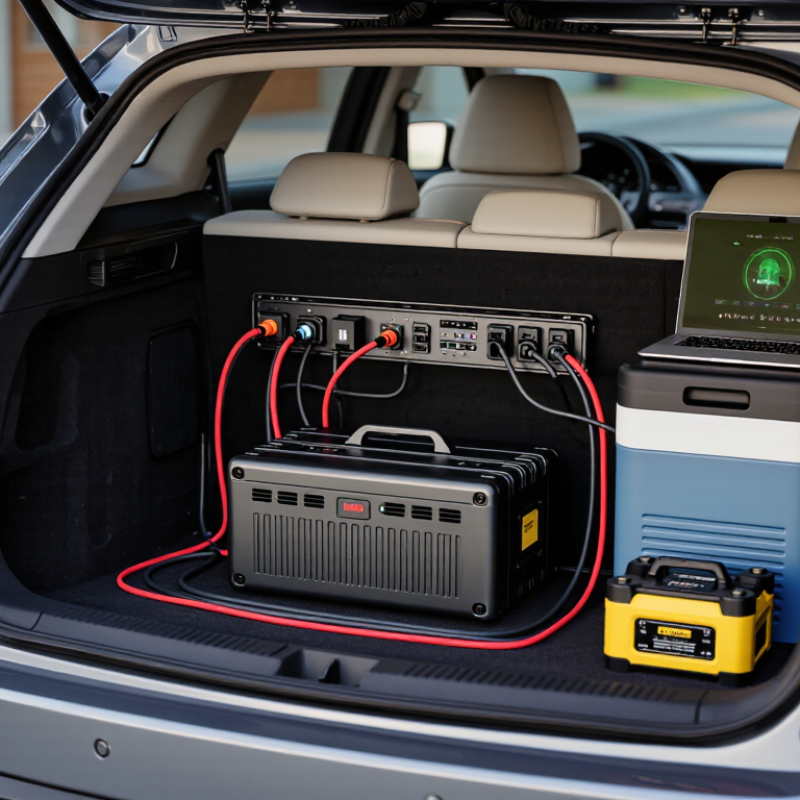
A car inverter charger combines two functions in one unit. It converts the vehicle’s 12-volt direct current into household-style alternating current for compatible devices. It can also charge a separate battery from an external power source. The exact features vary, so check the product specifications rather than relying on the name alone.
In practical use, the inverter might power a laptop at a roadside stop, while the charger replenishes a compatible battery at home or a campsite. Keep the setup grounded in real limits. A small inverter will not run every appliance, and high-demand devices can drain a vehicle battery quickly when the engine is off. Check wattage, battery voltage, charging current, and protection features before connecting equipment. A little margin helps.
Heat matters, too. Leave ventilation around the unit, keep cables secure, and stop using it if you notice a burning smell or unusual warmth. The manual is not thrilling, but it can prevent a costly mistake. Some specifications still feel confusing; comparing them with the devices you actually plan to use is a sensible place to start.
| Decision Factor | What It Means | Practical Guidance | Example or Check |
|---|---|---|---|
| Inverter and charger functions | An inverter converts the vehicle battery’s DC power into household-style AC power. A combination inverter-charger can also use an AC supply, such as shore power, to charge a separate battery. | Check whether the unit only converts DC to AC or also includes an AC battery-charging function. The word “charger” can refer to different functions in different products. | Confirm that the manual describes both “DC-to-AC inversion” and “AC-to-battery charging” if you need both. |
| Vehicle voltage | Most passenger cars use a 12-volt electrical system. Some larger vehicles and specialty setups use 24 volts. | Match the inverter’s DC input rating to the vehicle or auxiliary battery system. Never connect a 12-volt-only unit to a 24-volt system. | Check the vehicle manual or battery-system label before purchase. |
| Continuous output power | Continuous watts indicate the power the inverter can supply for sustained operation under specified conditions. | Add the running wattage of devices intended to operate at the same time, then allow headroom. Do not select by peak watts alone. | A 60 W laptop charger and a 40 W device require at least 100 W of continuous output, plus a suitable margin. |
| Surge capacity | Some appliances draw extra power briefly when starting, especially motors and compressors. | Check both the surge rating and how long it can be sustained. The inverter must support the appliance’s startup demand. | A small refrigerator may need substantially more power at startup than its normal running rating; consult its specifications. |
| Connection method | A vehicle accessory socket is generally intended for modest loads. Higher-power inverters typically require a direct battery connection with appropriately sized cables and fusing. | Follow the vehicle and inverter manuals. Do not exceed the socket’s stated current limit, and have high-current wiring installed correctly. | At 12 V, a 10 A socket provides about 120 W of DC input before conversion losses; the available AC output will be lower. |
| Waveform | Pure sine wave output closely resembles utility AC. Modified sine wave output is less smooth and may not suit every device. | Choose pure sine wave for sensitive electronics, some medical equipment, and devices whose manufacturers require it. Check each device’s instructions. | For a laptop, audio equipment, or a device with an AC motor, verify the required waveform before buying. |
| Efficiency and battery draw | Conversion is not lossless: the inverter draws more DC power from the battery than the AC load receives. | Use the stated efficiency as a guide, and remember that higher output and longer use drain the battery faster. Avoid prolonged use with the engine off unless the battery system is designed for it. | At 90% efficiency, supplying 180 W of AC power requires about 200 W of DC input, before accounting for other losses. |
| Battery charging specifications | On a combination unit, the charger function has its own charging current, supported battery types, and charging profile. | Match the charging profile to the battery chemistry and manufacturer’s limits. Confirm whether charging is from an external AC source, the vehicle alternator, or both. | Check compatibility with the battery’s stated chemistry, nominal voltage, and maximum recommended charge current. |
| Protection features | Protection systems can help respond to conditions such as overload, overheating, short circuit, and low or high input voltage. | Look for clearly documented protections and understand any warning or shutdown indicators. Protection features do not replace correct wiring or ventilation. | Verify that the unit specifies low-voltage shutdown and over-temperature protection. |
| Installation, cooling, and ventilation | Inverters can produce heat and may need clear airflow. High-current installations also require suitable cable size, short cable runs, and correctly rated fuses. | Install the unit in a dry, ventilated location and follow its clearance and mounting instructions. Keep it away from heat, moisture, and loose objects. | Use the cable and fuse sizes specified in the installation manual for the intended power and cable length. |
| Use case and runtime | The appropriate setup depends on what will be powered, for how long, and whether the engine will be running. | Estimate energy use in watt-hours, check battery capacity, and account for conversion losses. Do not assume an engine-off runtime from inverter wattage alone. | A 100 W load used for 2 hours consumes 200 Wh of AC energy; the battery must supply more than that because of inverter losses. |