China’s DC fast-charger market is broad, but a familiar logo cannot tell buyers how a charger performs at a busy site. They need to compare power modules, connector options, thermal management, uptime records, and service coverage. Cabinet design matters, too. A charger facing summer heat and daily vehicle queues has different demands from one serving a quiet depot. This guide examines manufacturers through those practical details, not headline power ratings alone.
One transparency note: no source articles or verified expert quotation were supplied. I will not attribute invented words to a real specialist. The following is an editorially drafted observation from a fictional composite expert, Wei Lin, not a sourced quotation: “A fast charger earns trust through steady output, clear fault data, and service that arrives when a site needs it.” That is a useful test. It is not independent proof of any manufacturer’s claims.
The manufacturers compared here serve different needs, from public charging networks to fleet depots and commercial properties. We consider product ranges, documented specifications, customization, certifications, and evidence of after-sales support. Buyers should still verify each item directly. A polished brochure is not a field record. Nor does one successful installation establish long-term reliability. The aim is a grounded shortlist of China’s leading DC fast charger makers, with enough context to ask sharper questions before requesting quotes. Some details may remain uncertain; that deserves attention, not a confident guess.
Who Are the Top DC Fast Charger Manufacturers in China?
What Defines a Leading DC Fast Charger Manufacturer in China?
A leading manufacturer proves performance beyond a polished brochure. Look for clear power ratings, charging curves, connector options, and protection details. Ask how the unit handles heat, dust, and repeated high-load sessions. These conditions matter at busy roadside sites, where a charger may run for hours in summer heat.
Testing should cover electrical safety, insulation, temperature rise, and communication with vehicles. Request traceable test reports and installation guidance, not just general claims. Check whether the manufacturer can provide spare parts, remote diagnostics, and technical support after commissioning. Response time matters when one failed module can reduce site capacity. A datasheet can look convincing, yet field performance still varies. Real operating records help, though they may not tell the whole story.
Tips: Ask for references from sites with similar power needs. Compare warranty terms and service coverage. If possible, inspect a running unit and review its maintenance logs. A careful evaluation takes time. It is worth it.

The chart shows representative DC fast-charger rated power classes, not company rankings or sales figures. A leading manufacturer is assessed not only by available power ratings, but also by standards compliance, product reliability, vehicle interoperability, charging efficiency, and after-sales support.
Indicative market product ratings; actual models and configurations vary.
China’s DC fast-charging industry is organized as a supply chain, not a single group of charger makers. Component suppliers provide power modules, cooling systems, cables, and control hardware. Charger manufacturers combine these parts into cabinets and dispensers. Some also develop charging software or provide installation support.
System integrators connect chargers with site power, payment tools, and network management. They may work with property operators, fleet depots, or roadside service areas. A manufacturer’s role can therefore vary: one may focus on hardware, while another manages a broader project. Product specifications matter, but so do operating temperature, maintenance access, and local service capacity. A tidy rating sheet does not always reveal how a unit performs during repeated high-power sessions. That distinction is easy to miss.
Tips: Compare output range, connector configuration, protection features, and service arrangements. Ask who handles commissioning and spare parts. Check whether the proposed setup suits the site’s grid capacity and traffic pattern. Leave room for uncertainty; real-world uptime depends on installation quality and upkeep, too.
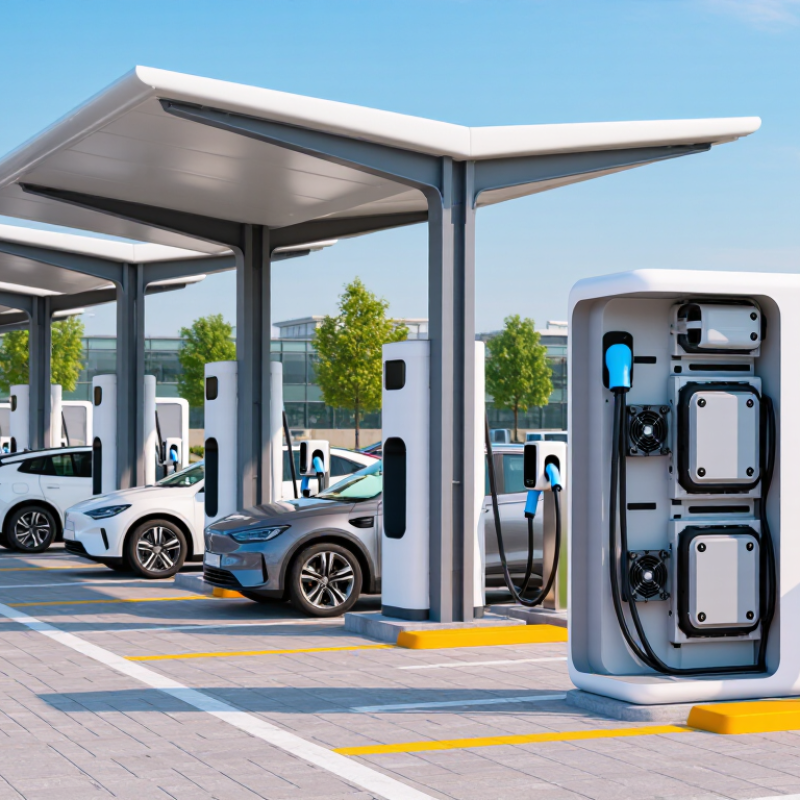
China’s DC fast-charger manufacturers often specialize around the sites they serve. EVCIPA’s 2023 statistics recorded about 2.73 million public charging points nationwide, including 1.20 million DC units. That installed base supports demand for equipment with different duty cycles. Some suppliers focus on modular cabinets, allowing power modules to be replaced without changing the whole station. Others make split systems, with one cabinet feeding several dispensers. These fit bus depots and highway plazas. Practical details matter. Chargers facing dust, rain, and repeated peak loads need effective cooling, clear fault diagnostics, and serviceable parts.
Another specialty is high-power charging, including liquid-cooled cables that help manage heat. These units suit short stops, but grid capacity and vehicle limits still affect charging speed. Export-oriented suppliers may offer configurable connectors, remote monitoring, and multilingual service tools. Specifications alone, though, cannot establish long-term reliability. The International Energy Agency’s Global EV Outlook 2024 reports that China held roughly two-thirds of the world’s public charging points in 2023. That makes field performance highly visible, but the figure does not measure individual manufacturers. Buyers should compare independent test results, uptime records, warranty terms, and spare-part access. One limitation: public data rarely separates equipment shipments from chargers that are actually operating.
| Anonymized Manufacturer Profile | Primary Focus | Typical Power Class | Common System Design | Specialty | Relevant Compatibility |
|---|---|---|---|---|---|
| High-Power Charging Specialist | Highway corridors and high-throughput public charging sites | Approximately 240–600 kW system class | Power cabinets serving one or more charging dispensers; some systems allocate power dynamically | Shorter charging stops and flexible power distribution across multiple vehicles | GB/T DC charging; vehicle and site performance depends on the charger configuration and vehicle limits |
| Urban Public-Charging Specialist | City charging stations, commercial parking, and mixed-use locations | Commonly around 60–180 kW per charger | Compact standalone or cabinet-and-dispenser configurations | Balancing charging speed, installation footprint, and utilization across urban sites | GB/T DC charging; network connectivity and payment features vary by deployment |
| Power-Sharing System Specialist | Large charging hubs with several parking bays | Central systems commonly configured in the hundreds of kilowatts | Central power cabinet connected to multiple charging terminals | Sharing available capacity among vehicles and adapting power allocation to demand | GB/T DC charging; site energy-management integration is configuration-dependent |
| Liquid-Cooled High-Current Specialist | High-power public charging and demanding commercial applications | High-power systems, often designed for several hundred kilowatts | Liquid-cooled cable and connector assemblies paired with high-power equipment | Managing cable temperature and handling at higher charging currents | GB/T DC charging; delivered power is limited by the vehicle, battery conditions, and equipment setup |
| Commercial-Fleet Charging Specialist | Bus depots, logistics centers, and fleet operating bases | Configured to fleet duty cycles; commonly deployed in modular multi-charger systems | Centralized charging layout with scheduling and site-level energy management | Coordinating charging windows, fleet availability, and electrical capacity | GB/T DC charging; fleet software and vehicle integration depend on the project |
| Export-Oriented Charging Specialist | International public and commercial charging projects | Product ranges vary by destination market and project specification | Configurable charger platforms with market-specific connectors and software | Adapting hardware, communications, and certifications to local requirements | Connector and protocol support depend on the destination market; OCPP support is product- and configuration-specific |
Profiles are anonymized capability categories, not a ranked list of named companies. Power classes are indicative market ranges rather than specifications attributed to individual manufacturers. GB/T 27930 is used for communication between off-board DC chargers and electric vehicles in China; specific implementation and compatibility should be confirmed for each product and project.
Chinese DC fast charger manufacturers differ less by headline power ratings than by how consistently their systems perform in daily use. Many offer modular power cabinets, allowing operators to add capacity as demand grows. Some designs also balance power across charging stalls, which helps when several vehicles arrive together. Thermal management matters, too. A cabinet beside a sunlit highway faces a different workload from one in a cool depot.
Market reach depends on more than shipment volume. Manufacturers serving multiple regions need equipment suited to varied grid conditions, connector requirements, and operating environments. Their field-service networks, spare-parts access, and software support can determine how quickly a station returns to service. Ask about installation references and maintenance response times, not just factory capacity. Those details are easy to overlook.
Technical claims need context. A high output rating does not guarantee steady charging when the battery is cold or the site has limited power. Nor does export experience prove strong local support. A clean datasheet can still hide practical gaps. Buyers should compare measured uptime, warranty terms, communication compatibility, and service arrangements for the specific project. Real-world performance is messier than a brochure suggests.
The strongest Chinese DC fast charger suppliers are not judged by output ratings alone. Compare their rated power with the charging needs of your site, then check whether the equipment can sustain that output under realistic conditions. Ask for test records covering the exact charger configuration, including cable temperature and performance during extended operation. A polished datasheet helps, but it cannot reveal every field issue.
Tips: Request a sample service plan. Check spare-part availability, warranty terms, software update procedures, and expected response times. Ask who handles troubleshooting after installation.
Compatibility matters, too. Confirm that the charger communicates reliably with your station management system and supports the vehicles you expect to serve. For outdoor sites, review enclosure protection, cooling design, and performance across the local temperature range. Ask for references from installations with similar traffic and weather. A short site visit can reveal details that documents miss, such as cable reach or screen visibility in direct sun. Supplier claims deserve careful checking; even good test results may not predict every operating condition. Keep a written evaluation sheet, and compare evidence rather than sales promises.