How to Choose the Best Home Car Charger for Your EV?
Choosing the best Home Car Charger for your electric vehicle (EV) can be daunting. In recent years, the EV market has accelerated. According to the International Energy Agency, global EV sales doubled in 2021, signaling a growing demand for efficient charging solutions. Experts predict that by 2030, there will be over 300 million electric cars on the road. This surge emphasizes the importance of reliable home charging options.
Renowned industry expert, Dr. Sarah Thompson, states, "A smart Home Car Charger not only saves time but also enhances the overall EV experience." With various types available, selecting the right charger involves more than just convenience. Factors such as charging speed, installation requirements, and compatibility with your EV model are crucial. In this rapidly evolving market, staying informed can make all the difference.
However, many consumers overlook the importance of researching the best options. Not every charger offers the same efficiency or features. Understanding your specific needs is vital in making an informed choice. Taking the time to evaluate different chargers can ultimately save you both money and time in the long run.
Understanding EV Charging Basics: Voltage and Current Explained
Understanding the basics of electric vehicle (EV) charging is crucial for selecting the right home car charger. Voltage and current are key factors in determining charging speed and efficiency. EV chargers are typically categorized by Level 1 and Level 2. Level 1 chargers use standard household outlets, providing 120 volts of power. They usually deliver about 4 to 5 miles of range per hour. In contrast, Level 2 chargers operate at 240 volts, offering up to 25 miles of range per hour.
A recent report by the International Energy Agency (IEA) states that the demand for faster charging solutions is skyrocketing. Many EV owners desire quick charging options that can accommodate their daily routines. Research indicates that the majority of EV drivers prefer to charge overnight, relying on Level 2 chargers for convenience. However, it is essential to consider your home’s electrical capacity. Upgrading to a Level 2 charger may require additional costs for electrical work.
Understanding amperage is also critical. Most Level 2 chargers operate at 16 to 40 amps. A typical setup might provide 32 amps, translating to about 7.7 kW of power. This can safely charge a standard EV in 4 to 8 hours. However, not all homes can sustain higher amperages without upgrading wiring. Charging too quickly on inadequate infrastructure may lead to overheating or malfunction. Balancing charging speed with safety and cost is essential for optimal performance.
How to Choose the Best Home Car Charger for Your EV? - Understanding EV Charging Basics: Voltage and Current Explained
| Charger Type |
Voltage (V) |
Current (A) |
Power Output (kW) |
Charging Time (hours) |
| Level 1 Charger |
120 |
12 |
1.44 |
8-20 |
| Level 2 Charger |
240 |
30 |
7.2 |
4-8 |
| DC Fast Charger |
480 |
100 |
50-150 |
0.5-1 |
| Portable Charger |
120/240 |
16 |
1.92/3.84 |
8-10 (120V) / 4-6 (240V) |
Types of Home Car Chargers: Level 1 vs Level 2 Charging Options
When choosing a home car charger for your electric vehicle (EV), understanding the differences between Level 1 and Level 2 charging is crucial.
Level 1 chargers use a standard 120-volt outlet. They are widely available but can be slow, providing about 4 to 5 miles of range per hour. This option is ideal for overnight charging if daily commutes are under 40 miles. According to the U.S. Department of Energy, about 80% of EV owners rely on Level 1 chargers at home.
Level 2 chargers operate on a 240-volt outlet. They charge much faster, offering 10 to 60 miles of range per hour, depending on the vehicle and charger specifications. For most electric vehicles, a Level 2 charger can fully charge the battery overnight. A study from the Electric Power Research Institute states that Level 2 chargers account for nearly 75% of public charging stations and are increasingly common in residential settings.
Choosing between the two options depends on usage patterns and lifestyle. If you drive long distances or have a busy schedule, the faster charging of Level 2 might be necessary. Yet, many homeowners do not upgrade from Level 1 due to installation costs. It’s essential to evaluate home electrical capacity and installation requirements realistically. Seek guidance from a qualified electrician to ensure the safest and most efficient setup.
Key Features to Consider: Cost, Speed, and Connectivity
Choosing the best home car charger for your EV can be daunting. Focus on three key features: cost, speed, and connectivity. According to industry reports, more than 60% of EV owners prioritize charging speed. This aspect greatly influences daily usage and convenience. For example, Level 2 chargers can deliver up to 25 miles of range per hour. This is essential for drivers who rely on quick top-ups after work or errands.
Cost is another significant factor. Installation fees can vary widely based on location and existing electrical infrastructure. Research suggests that the average installation cost ranges from $1,200 to $3,000. Consider your budget and long-term energy savings when making a decision. A more expensive charger may pay off in quicker charging times and enhanced features.
Connectivity options also matter. Many modern chargers offer Wi-Fi or smartphone integration, enhancing user experience. Being able to monitor charging sessions or receive notifications can be convenient. However, this advanced tech can sometimes lead to connectivity issues. Ensure your home Wi-Fi is strong enough to support these features.
Tip: Always check for rebates or incentives from local governments or utilities. These can significantly lower your overall costs. Another tip is to assess your daily driving needs accurately. This helps you choose a charger that fits your lifestyle best. Balancing these factors is crucial for a satisfying EV ownership experience.
Installation Requirements: Home Electric System Compatibility
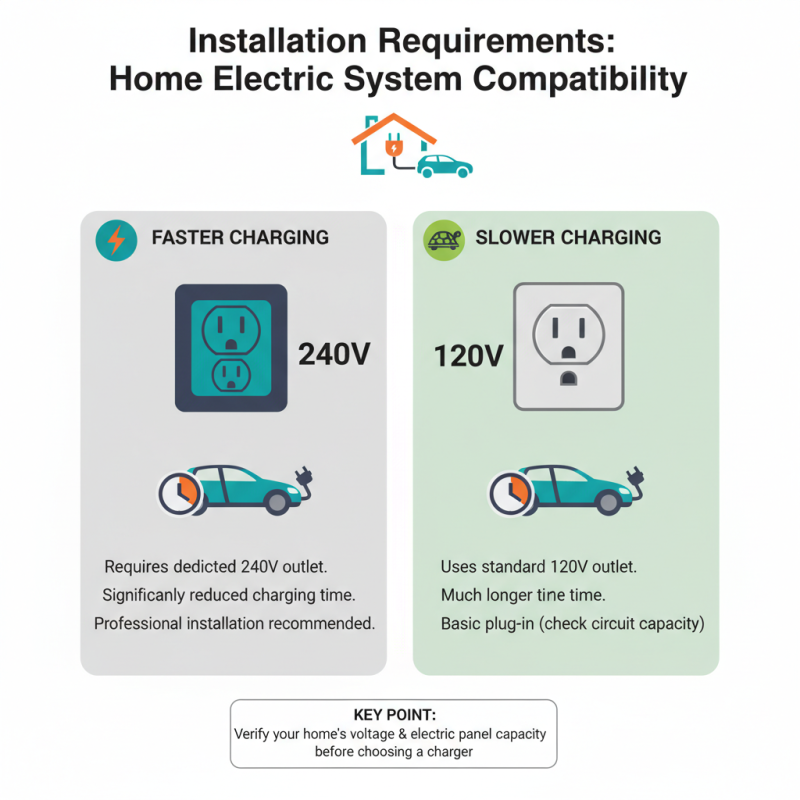
When choosing a home car charger for your electric vehicle, installation requirements are crucial. Your home’s electric system must support the charger’s power needs. Check the voltage available at your location. Most chargers require a 240-volt outlet for faster charging. If you only have a standard 120-volt outlet, charging time will significantly increase.
Consider the condition of your electrical system. Older homes may require upgrades to handle additional load. An electrician can assess your system’s capacity. If your home uses a fuse box, it might indicate the need for modernization. Even small details, like circuit breaker ratings, matter. They ensure safety and efficiency during charging.
Think about where you plan to install the charger. A convenient location can improve your charging habits. However, proximity to the power source must also be considered. A long extension cord is not safe or effective. In some cases, installing a new circuit might be necessary. It requires careful planning and professional help. Consider these aspects to ensure a smooth experience with your new electric vehicle charger.
Safety Standards and Certifications: Ensuring Safe Charging Practices
When selecting a home car charger for your electric vehicle (EV), safety should be a top priority. The National Fire Protection Association reports that improper charging practices contribute to a significant percentage of electric vehicle fires. This highlights the necessity of adhering to safety standards and certifications. Look for chargers that meet the Underwriters Laboratories (UL) and International Electrotechnical Commission (IEC) standards, as these certifications ensure rigorous testing for safety and performance.
There are various types of chargers, but not all are created equal. Level 2 chargers, for instance, are typically recommended for home use due to their faster charging capabilities. However, some low-quality models may lack essential safety features. This can pose risks like overheating and electrical failures. A report by the Electric Vehicle Association indicates that chargers equipped with built-in overheating protection decrease the risk of accidents. When choosing a charger, evaluate its safety features; choose models that include surge protection, ground fault circuit interrupters (GFCIs), and automatic shut-off functions.
User feedback is invaluable in assessing reliability. Online reviews often reflect real-world experiences, shedding light on any recurring issues. Despite the rigorous standards, not all certified chargers perform as expected. Some users note that chargers can fail prematurely or struggle with compatibility. Ensuring a safe charging environment involves more than just compliance; it also means addressing potential shortcomings through research and testing based on user experiences.
EV Charger Safety Standards and Certifications